Granite vs Epoxy vs Phenolic Laboratory Worktops: How to Choose for Your Application
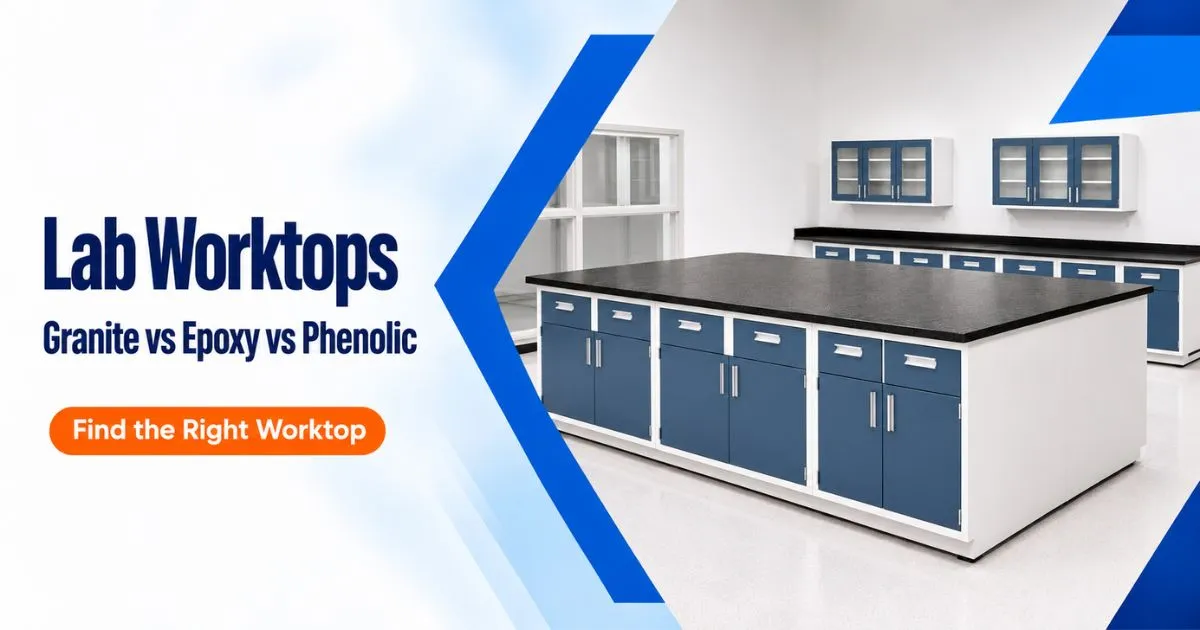
Choosing laboratory worktop materials starts with what happens at the bench. A dry instrument station, a school chemistry workstation and a frequently washed preparation area can require different surfaces, even within the same laboratory.
Granite, epoxy resin and phenolic resin each offer useful characteristics. The right choice depends on the proposed product, chemical exposure, heat, cleaning routine and installed furniture system. A material name alone cannot establish suitability.
As a starting point, consider granite where the specified stone suits the exposure and the bench can support it. Shortlist laboratory epoxy when a cast resin surface and compatible sink options fit the work. Consider laboratory-grade phenolic where panel construction, handling weight and fabrication flexibility are valuable. Verify each option against the activities planned for that position.
Compare laboratory worktop materials at a glance
| Buying factor | Granite | Epoxy resin | Phenolic resin |
|---|---|---|---|
| Construction | Natural stone slab | Cast and cured resin composite | Pressed resin-and-fibre panel with a specified surface |
| Reason to shortlist | Hard stone surface where compatibility is established | Monolithic laboratory surface with moulded product and sink options | Laboratory-grade panels that can simplify handling and fabrication |
| Main selection risk | Assuming every stone and treatment resists the same chemicals | Assuming every epoxy formulation has identical performance | Confusing standard decorative grades with chemical-resistant grades |
| Installation focus | Slab support, joints, cut-outs and access | Weight, fabrication, support and sink details | Panel grade, spans, cut-outs and fixing details |
| Maintenance focus | Stone-compatible cleaning and treatment requirements | Preserve the finish and inspect sinks and joints | Preserve the specified surface and follow product care instructions |
Use this comparison of lab countertop materials to build a shortlist. Complete the decision using product data and a drawing of the finished workstation.
Granite laboratory worktops and their limitations
Since granite is a naturally occurring stone, the identity, mineral makeup, finish, and any treatments applied to the supplied slab are important. Instead of depending just on a description like “black granite,” specify the desired stone.
Sealing increases stain resistance without making stone stain-proof, according to the Natural Stone Institute’s care guidelines. Additionally, it indicates that granite can be attacked by hydrofluoric acid. Therefore, general stone-care information should not be regarded as evidence of chemical compatibility in a laboratory.
After the exposure and support requirements are evaluated, granite may be taken into consideration for appropriate dry workstations or instrument positions. For a balance or other sensitive instrument, its mass does not provide vibration isolation on its own.
Examine the support beneath joints, edges, and cutouts. Incorporate any suggested treatment and its upkeep needs into the quote.
Epoxy resin laboratory countertops and their limitations
Laboratory epoxy resin countertops are cast composite products. Established laboratory ranges can provide solid work surfaces, sinks and accessories designed to work together. This makes epoxy a useful candidate when the project needs coordinated wet-work details and documented chemical resistance.
Durcon describes its epoxy products as having a consistent, non-porous composition through the material. That is a statement about its identified product range, rather than a specification for every epoxy surface sold in the market. Confirm whether the quotation covers a laboratory resin worktop, a coating over another substrate, or an epoxy powder-coated metal frame.
These describe different products and components. Epoxy’s weight, fabrication requirements and vulnerability to particular damage mechanisms still need consideration. Review lifting access, supports, cut-outs and the manufacturer’s heat and care instructions. A chemical-resistance claim does not mean the surface is scratch-proof or suitable for unrestricted contact with hot equipment.
Phenolic resin countertops and their limitations
Phenolic tops are presented as compact panels which are formed by pressing resin impregnated fibers or paper between heat and pressure. In terms of construction they do offer some handling and fabrication advantages over heavier cast epoxy tops. For a comparison of epoxy and phenolic products check the actual weight and installation needs at the quoted thickness.
The important purchasing distinction is the product grade and surface technology. General plastic laminate, a decorative compact panel and a chemical-resistant laboratory panel should not be treated as interchangeable.
Durcon’s SPC-CR specification, for example, distinguishes chemical-resistant and standard-grade constructions. Other manufacturers also publish product-specific surface and chemical-resistance information. For school laboratories, phenolic resin countertops deserve consideration where the selected grade meets the practical programme and cleaning requirements.
Avoid rejecting or approving the entire material family from a general statement about moderate-duty use. Compare the named product with the substances and conditions at the bench.
Specify a chemical-resistant laboratory table using an exposure list
A chemical-resistant laboratory table should be assessed against the actual substances it will encounter. Ask the laboratory team to record:
- Reagents and cleaning or disinfecting products.
- Concentrations and expected contact temperatures.
- Likely contact duration and frequency.
- Equipment loads, wet areas and service openings.
- The cleaning and maintenance routine the team can follow.
Request a chemical-resistance report for the proposed worktop grade and finish. Read the method and results alongside the chemical list.
The SEFA 3-2020 Laboratory Work Surfaces Standard reports chemical test methods which use 24 hour exposure at 23 ± 2°C. Those conditions are put forth to what a result will include. They do not determine performance at all temperature, concentration or operation settings. Ask the supplier for any omissions in that regard. A single over all rating is not as useful as that which comes from the results of the substances relevant to your work.
Compare heat resistance without relying on one temperature
Dry heat, wet heat and a rapid temperature change are different conditions. A temperature shown in a datasheet needs its test method and duration to be meaningful. For example, Durcon’s published SPC-CR specification lists separate dry-heat assessment at 160°C and wet-heat assessment at 100°C using different methods. These are test conditions for the named product, rather than universal operating limits for phenolic worktops. An epoxy or granite surface also needs appropriate protection. Durcon’s epoxy care guidance recommends a trivet beneath hot containers and components. Establish the required equipment supports and protective arrangements before the laboratory begins using the bench. The same review should cover cold exposure and thermal shock where relevant. Follow the worktop and equipment manufacturers’ instructions instead of converting a heat-resistance statement into permission for every application.
Coordinate lab countertops and cabinets with sinks and joints
Lab countertops and cabinets form one workstation. The surface, frame, storage and service connections should be reviewed together. For a laboratory sink, confirm the basin material, mounting method, supports, cut-out and joint detail. Moulded epoxy options can provide useful configurations, but the installed assembly still needs correctly specified connections and accessible joints. For granite or phenolic tops, review the fabricated openings and the proposed sink arrangement rather than assuming the panel or slab determines the entire wet area’s performance. Include joint locations, adhesives or sealants, splash protection and maintenance access in the drawing. A resistant worktop cannot compensate for an unsuitable joint or an inaccessible leaking connection. When replacing a top, inspect the retained frame and cabinets. Their condition and support arrangement must suit the replacement material, equipment and span.
Cleaning and maintaining laboratory countertops
How to clean epoxy countertops
Follow the laboratory’s procedures and the identified manufacturer’s care instructions. Durcon’s published epoxy guidance warns against wax-containing polish and abrasive cleaning products that can dull its surfaces. It also calls for attention to sink and joint condition.
Agree the approved cleaning products before purchasing. A cleaner suitable for one surface or contaminant may not suit another material, coating or joint.
Caring for phenolic and granite surfaces
For phenolic tops, use instructions for the exact grade and finish. Do not assume a general laminate cleaning guide covers the laboratory panel being supplied.
For granite, include any stone-treatment requirements in the maintenance plan. Check that the proposed cleaning routine is compatible with the stone and its treatment.
Cleanability, bacterial-growth resistance and sterility are different claims. Request the relevant evidence where hygiene performance matters, and retain the laboratory’s required cleaning or disinfection procedures.
Compare repairability before approving the worktop
Ask what happens after a chip, deep scratch, damaged joint or cracked section. The answer affects downtime and future cost.
For granite, establish whether local repair or replacement is practical and how the repaired area would be assessed for the intended exposure. For epoxy, obtain the manufacturer’s procedure for the particular defect and finish.
For phenolic, distinguish a cosmetic mark from damage to the functional surface. Sanding, polishing or applying a repair product may change the finish or remove part of a protective layer. Obtain written advice before treating those methods as acceptable repairs.
Also ask whether one worktop section can be replaced without removing neighbouring sinks, cabinets or equipment. A replacement arrangement is useful only when the laboratory can obtain the part and access it for installation.
Compare the total installed cost of laboratory worktops
The cheapest slab or panel does not necessarily produce the lowest installed quotation. Compare granite, epoxy and phenolic using the same bench drawing and scope. Include fabrication, edges, cut-outs, sinks, supports, joints, delivery, unloading and installation. Confirm the thickness and grade behind each rate, and identify taxes and exclusions separately. Ask how repairs, replacement sections and future alterations would be handled. For modular lab furniture, consider the weight and connections involved in moving or reconfiguring the bench. A useful cost comparison records the initial purchase and the practical maintenance arrangements. It should not assume that one material is always the cheapest across every project and supply location.
Match the worktop to the laboratory application
Example one a CBSE school with different workstation activities
Consider a school planning dry apparatus benches, sink stations and chemistry demonstration areas. This is an illustrative buying example, rather than a completed Labsolute project. The team can assess granite for suitable dry positions, compare laboratory-grade epoxy and phenolic for chemical work, and examine the full sink assembly for wash-up areas. The practical programme, exposure list and available evidence determine the shortlist for each position. The resulting schedule may use more than one material. The school should record why each selection suits its position and what documentation the supplier must provide.
Example two a quality control laboratory upgrading wet benches
A quality control team may place greater emphasis on its reagent list, repeated cleaning and equipment requirements. It should compare the named epoxy and chemical-resistant phenolic products against those conditions, rather than choose solely from a general teaching-versus-research classification.
Before ordering, the team resolves the chemical evidence, sink details and replacement scope. This produces a specification that a supplier can answer and the laboratory can check at handover.
A checklist for choosing the right lab table top material
Give shortlisted suppliers a consistent enquiry containing:
- Laboratory activities and the exposure list for each workstation.
- Measured dimensions and the drawing revision used for pricing.
- Equipment footprints, loads and installation requirements.
- Worktop product, grade, finish, colour and thickness.
- Relevant chemical and heat test information.
- Sink, joint, edge and service-opening details.
- Support and installation responsibilities.
- Cleaning instructions, repair guidance and warranty scope.
Record proposed substitutions explicitly. A replacement product should be assessed against the same brief before the order or drawing is changed.
Frequently asked questions
Which is the best laboratory worktop material
Choose according to the activities, chemicals, heat, cleaning and installed configuration. Granite, epoxy and laboratory-grade phenolic can each suit particular applications. The evidence for the proposed product matters more than a general material ranking.
Is granite suitable for chemistry lab countertops
Only where the proposed stone, treatment and complete installation have suitable compatibility for the planned work. Do not assume a kitchen-countertop description proves laboratory suitability. Review joints, cut-outs and the intended chemical exposure before approving the specification.
Is a phenolic countertop the same as ordinary laminate
Laboratory phenolic panels and ordinary decorative laminate can differ in construction, grade and surface performance. Request the exact product identification and resistance information. The word laminate alone does not establish suitability for chemical work.
Can hot equipment be placed directly on epoxy or phenolic worktops
Follow the specific worktop and equipment instructions. A test temperature does not establish unrestricted direct-contact use. Confirm the required protective supports and assess thermal shock as well as normal operating heat.
Can one laboratory use different worktop materials
Yes. Specify each workstation against its own activities and exposure. Coordinate the different materials with their supports, sinks, joints and cleaning instructions, then record the accepted products in the furniture schedule.
Discuss worktop options for your laboratory activities
Review Labsolute Innovation’s laboratory furniture range and share your floor plan, equipment requirements, chemical list and intended cleaning routine through the project enquiry page.
Request a discussion of suitable worktop options with named product specifications and a clear installation scope. This gives your team a practical basis for comparing materials and selecting furniture for the work it needs to support.